What a CEO Should Know About AI Agents
A practical executive guide to what AI agents can do, how they differ from chatbots and copilots, and the questions CEOs should ask before granting more autonomy.
A chatbot can answer a question. A copilot can help an employee work faster. An AI agent goes further: it can use data, tools, and business systems to move an objective forward.
That difference matters for a CEO.
Once AI starts taking action, the conversation is no longer only about individual productivity. It becomes a question of processes, access rights, decision authority, risk, and accountability.
Executives do not need to become AI engineers to understand this shift. But they do need to understand what they are actually authorizing when they deploy an agent.
> 30-second takeaway
> An AI agent is not simply a smarter chatbot. It can carry out multiple steps and, depending on the permissions it receives, act inside company systems. For a CEO, four ideas provide a useful starting point: objective, access, authority, and control.
Why everyone is talking about AI agents
Much of the AI used in companies so far has primarily been assistive: it writes, summarizes, searches, and analyzes. A person usually remains responsible for turning the output into action.
AI agents begin to change that relationship.
The Canadian Centre for Cyber Security describes agentic AI as systems that can interpret their environment, reason, make decisions, use external tools and data, and take actions to achieve goals. The important distinction from traditional generative AI is therefore not simply whether it produces a better answer. It is whether it can pursue an objective and act.
Companies are preparing for that shift quickly. In research published by Deloitte in August 2026, 74% of surveyed leaders expected a significant share of their business processes to be redesigned or rebuilt around AI agents within four years. Yet only 5% of surveyed organizations said their business processes were highly prepared for agentic adoption.
The ambition is moving faster than the operating model.
Chatbot, copilot, and AI agent: three different roles
| | Chatbot | Copilot | AI agent |
|---|---|---|---|
| Answers a request | Yes | Yes | Yes |
| Helps an employee do work | Limited | Yes | Yes |
| Can use multiple tools | Sometimes | Sometimes | Yes |
| Can carry out multiple steps | Limited | Limited | Yes |
| Can act inside business systems | Rarely | Sometimes | Yes, depending on permissions |
| Can pursue an objective with less human involvement | No | Usually not | Yes |
These categories are not perfectly rigid. Products evolve quickly, and vendors do not always use the terms in exactly the same way.
For a CEO, the label matters less than the progression from responding to assisting, and from assisting to acting.
!Progression from chatbot to copilot to AI agent.
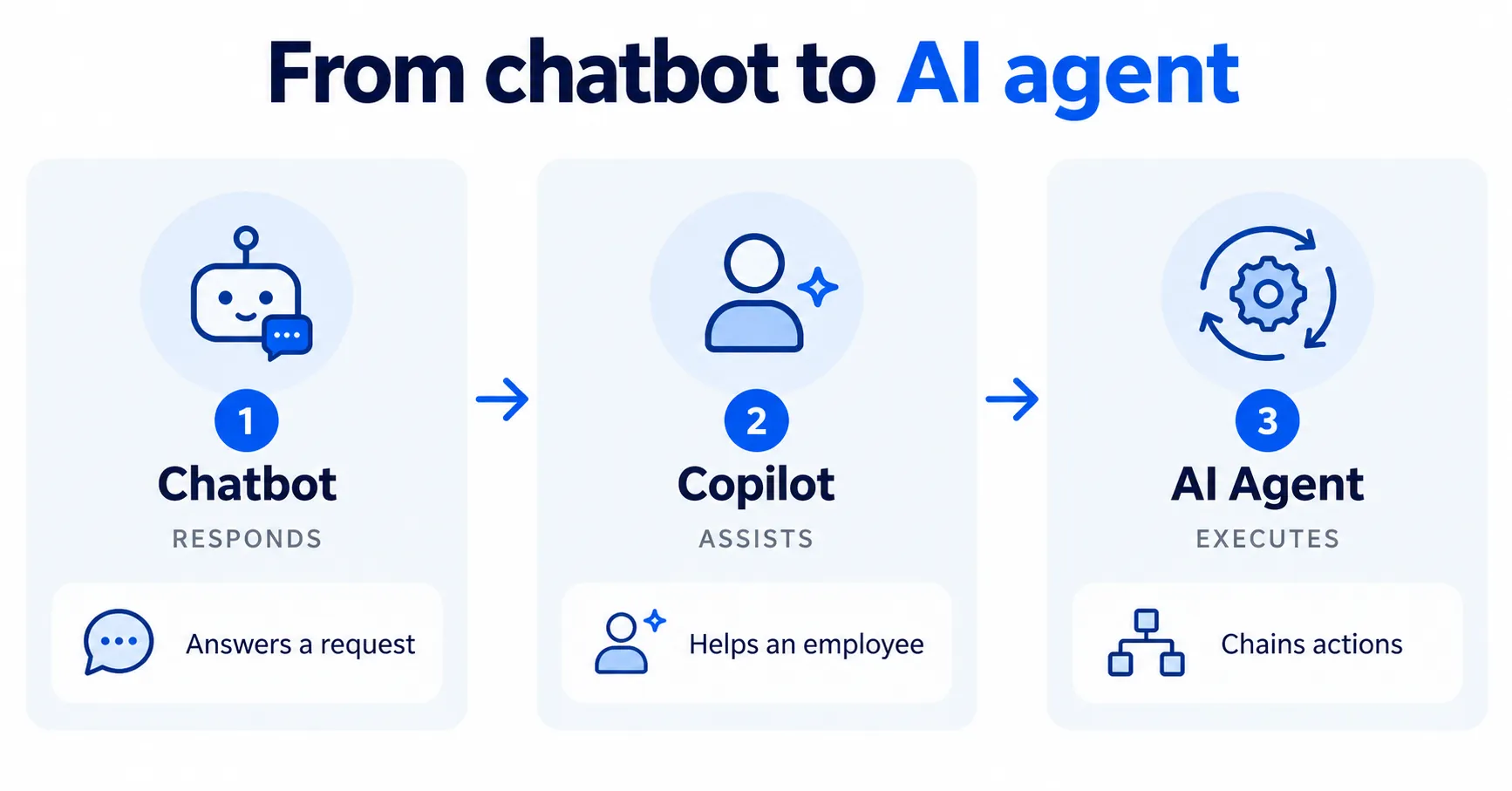
The progression from a chatbot that responds, to a copilot that assists, to an AI agent that can execute multiple steps.
A simple example
Imagine a customer emails your company asking for a service intervention.
A chatbot can explain how to submit a request.
A copilot can read the email, summarize it, and suggest a response to the employee.
An agent can go further. It can read the request, identify the customer, check the customer record, verify relevant information, create the service request in the appropriate system, prepare a response, and route exceptions to a human.
At that point, the technology is no longer only producing content. It is participating in the process.
That is when the subject becomes a management issue.
The four concepts a CEO needs to understand
You do not need to understand the inner workings of large language models, vector databases, or integration protocols.
You should, however, be able to answer four questions.
1. What is the objective?
An agent works toward an objective.
“Help customer service” is too vague.
“Classify incoming requests, open eligible cases, and route exceptions to an employee” is much clearer.
The more precise the objective, the easier it becomes to measure performance and constrain unwanted behavior.
2. What can it access?
An agent becomes much more useful when it can access company data and systems. That access also creates risk.
Can it read every customer file, or only the ones required for its task? Can it see pricing? Financial information? Personal information? Email?
The Canadian Centre for Cyber Security explicitly recommends applying the principle of least privilege: give an agent only the minimum rights it needs for its task and limit access to the exact resources, operations, and timeframes required.
3. What is it allowed to do?
Accessing information and having authority to act are two different things.
An agent might be allowed to view a customer balance without being allowed to change a credit limit. It might prepare a refund without being able to issue it. It might create a service request automatically but require approval before granting a large discount.
This is where the word autonomy becomes practical.
Autonomy is not simply a feature that is on or off. It is a set of action rights that the organization chooses to grant.
4. How do we remain in control?
An agent can carry out several steps much faster than a human. That speed makes oversight more important, not less.
The organization needs to know what the agent did, which permissions it used, what rules applied, and when a human should intervene.
Deloitte reported in April 2026 that only 21% of surveyed organizations had a mature governance model in place for agentic AI. In many companies, the technology is therefore advancing faster than the management model around it.
!The four key questions for governing an AI agent: objective, access, authority, and control.
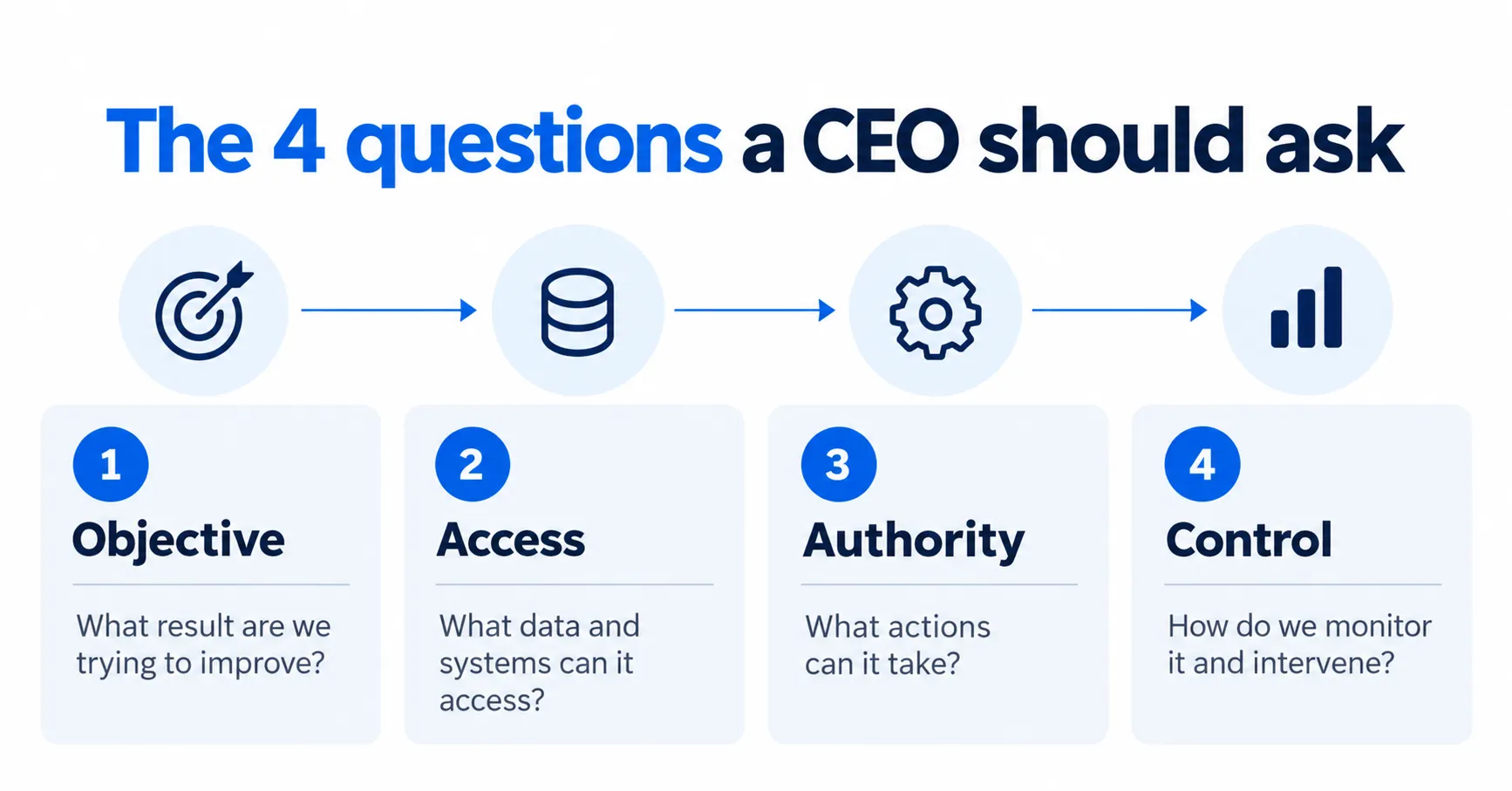
Four questions can structure the first executive conversation about an AI agent: objective, access, authority, and control.
What a CEO does not need to master
You will probably hear terms such as LLM, RAG, embeddings, orchestration, reasoning models, and MCP.
Those terms may matter to the teams building the system. They should not be the starting point of an executive conversation.
A better CEO conversation sounds like this: What result are we trying to improve? What data can the agent access? What decisions can it make? What actions can it execute? What still requires a human? How will we measure performance? How will we know what happened if something goes wrong?
If your team can answer those questions clearly, you are already further ahead than if it can simply show you a long feature list.
A CEO does not need to know how the engine works to decide where the vehicle can go, who is allowed to drive it, and which rules it must follow.
Five questions to ask your team
- What specific business outcome should this agent improve?
- Which data and systems will it need to use?
- Which actions can it execute without approval?
- Which situations must automatically be handed to a human?
- How will we measure, monitor, and reconstruct its actions?
These questions do not replace specialists. They allow the CEO to play the CEO's role.
The shift to remember
An AI agent is, above all, a new operational capability.
The more that capability can act, the clearer the company must be about its objectives, access, authority, and limits.
A CEO does not need to understand every line of the technology.
A CEO needs to understand what the organization is allowing it to do.