Human-in-the-Loop Does Not Mean Human-in-Every-Loop
Too many human approvals can become a new bottleneck. Put human judgment where risk actually changes.
An AI agent receives a customer request.
It identifies the customer, checks the CRM, consults the ERP, prepares the service action, and updates the case.
Then it stops.
Approval required.
Someone clicks.
The agent moves one step forward.
Approval required.
Someone clicks again.
The company has technically deployed autonomous AI. What it may have actually created is a very sophisticated digital waiting line.
> 30-second takeaway
> Human-in-the-loop does not mean a person should approve every action. Effective oversight depends on risk, reversibility, and uncertainty. Automate low-impact, easily reversible actions; place human judgment where an error could have a material consequence or be difficult to undo.
More oversight does not always mean more control
Once an AI agent can act inside a CRM, ERP, or financial system, adding human approval seems like the safest response.
But human presence does not automatically create effective control.
NIST notes that human-AI configurations can range from fully manual to fully autonomous, and that the appropriate level of oversight depends on the use case.
If someone receives 150 nearly identical requests every day and approves almost all of them, that person can gradually move from decision-maker to confirmation button.
NIST also identifies automation bias: humans may over-rely on automated systems.
An experiment cited by the OECD in 2026 found that conversational explanations from GenAI-based robo-advisers increased users’ confidence even when the advice was wrong.
Clicking “Approve” is not necessarily the same as exercising judgment.
Not every action deserves the same control
The Canadian Centre for Cyber Security recommends a risk-based approach, classifying agent actions by potential impact, likelihood, and reversibility.
| Risk | Reversibility | Recommended mode |
|---|---|---|
| Low | Easy | Automatic |
| Medium | Easy | Automatic within rules |
| Medium | Difficult | Act with approval |
| High | Any | Human approval |
| Uncertain or anomalous | Variable | Human escalation |
The better question is not “Should a human be involved?” It is “Where does human judgment materially change the risk?”
Approval should be a decision, not decoration
Useful approval requires context.
The reviewer should ideally understand what action is being proposed, why, which important data informed it, what rule or anomaly triggered escalation, what consequences are expected, and whether the action can be reversed.
> The management point
> Human approval creates value when it adds judgment, context, or authority. If it simply rubber-stamps what the AI already proposed, it mostly adds latency.
Autonomy should be earned
The same process can progress through stages:
- Observe
- Recommend
- Act with approval
- Act automatically
The Canadian Centre for Cyber Security recommends graduated autonomy, continuous evaluation, and the ability to roll back permissions or scope when failures appear.
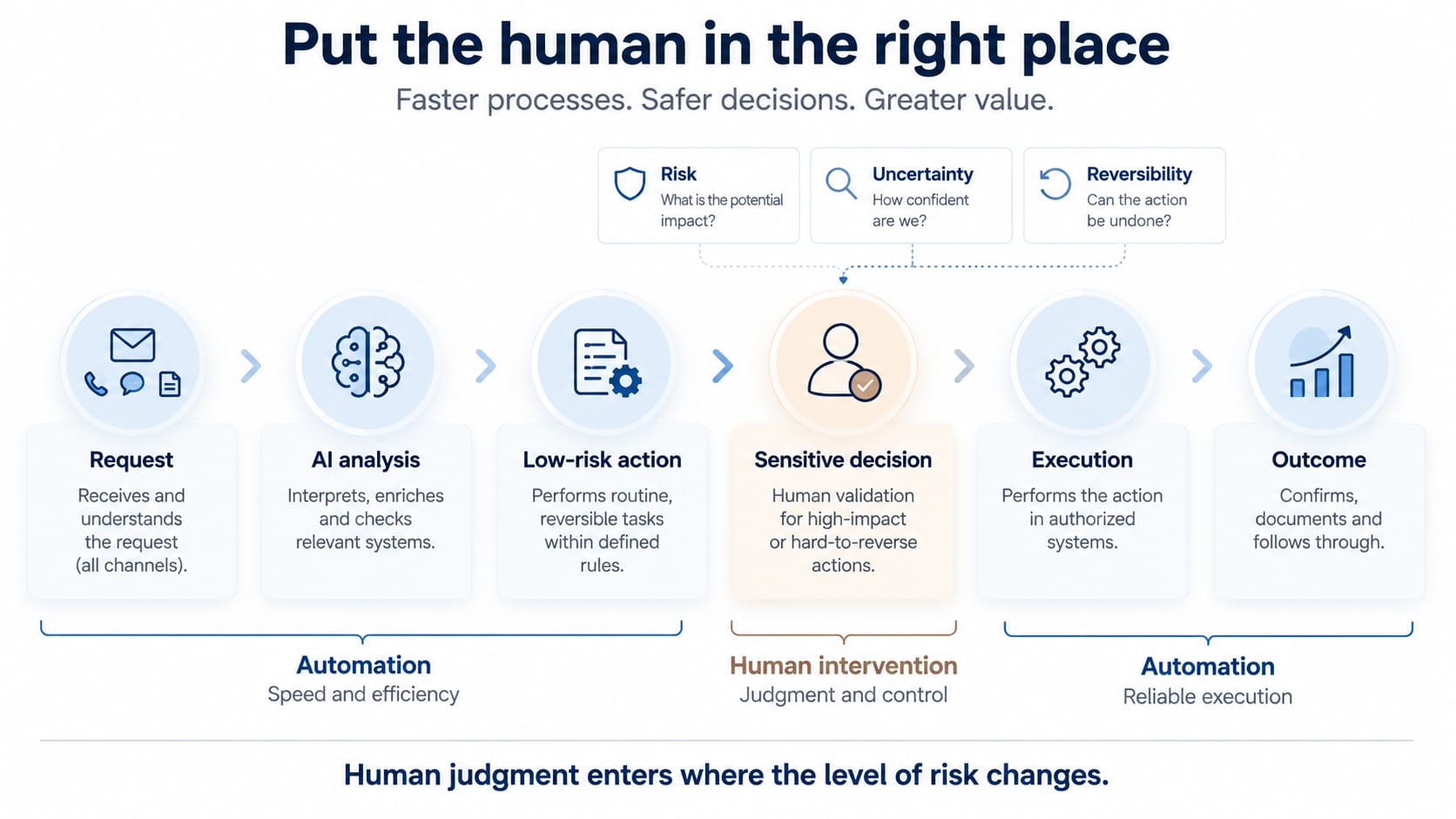
Most of the workflow can be automated. Human judgment enters where risk, uncertainty, or irreversibility changes.
Too many approvals can create their own risk
Systems that constantly ask people to confirm routine actions can create fatigue, automatic behavior, and declining attention.
Sometimes two meaningful human decisions per day provide more control than 200 clicks that no longer feel like decisions.
What you can do Monday morning
Choose one AI workflow already in production or pilot. List every human intervention inside it.
For each approval, ask:
- What happens if this action is wrong?
- Can the action be easily reversed?
- Does the human actually have more context than the agent?
- How often is this approval rejected or modified?
- What would need to be measured before granting more autonomy?
> 30-minute exercise
> Review the last 30 approvals in one workflow. If 29 were accepted without modification, do not automatically remove the control — but ask whether the control is located at the right point.
Human-in-the-loop remains essential for many processes.
Its value comes precisely from the fact that it does not need to be everywhere.
Put the human in the right place. Not in every loop.