Don’t Measure Your AI by How Many Agents You Deploy
Deploying more AI agents does not guarantee more value. A simple method to connect every AI initiative to a real business outcome.
Don’t Measure Your AI by How Many Agents You Deploy
Estimated reading time: ~4 min
On September 22, 2026, SAP is demonstrating AI agents applied to practical finance, supply chain, and spend-management processes.
SAP now highlights more than 200 specialized AI agents. That is impressive. But for an executive, that number is still not a business outcome.
A company can have 3, 30 or 300 agents and still have no clear answer to whether costs are falling, cycle times are improving, or customers are receiving better service.
> 30-second takeaway
> The number of AI agents, users and automated tasks primarily measures deployment. To measure value, connect every meaningful AI initiative to a business metric the organization already cares about: cost, speed, capacity, revenue, quality or risk. Don’t just count what AI does. Measure what it changes.
The trap of metrics that look like progress
AI dashboards often start with the easiest numbers to collect:
- agents deployed;
- active users;
- conversations;
- automated tasks;
- adoption rates.
Those numbers are useful. They tell you whether the technology is being used.
But they answer “Are we using AI?”
They do not necessarily answer “Is AI making the business better?”
That distinction matters.
In McKinsey’s latest global AI survey, 80% of respondents said AI had improved their individual productivity, while only 37% attributed any EBIT impact to their organization’s use of AI.
In other words, employees working faster does not automatically mean the company is becoming more profitable.
Measure the process, not the agent
The simplest way to avoid this trap is to start with a metric the company tracked before AI arrived.
Customer service already measures resolution time.
Finance knows how long the monthly close takes.
Sales tracks conversion and response times.
Procurement can track off-contract spend.
Operations knows its cycle times, error rates and throughput.
AI does not need its own definition of success.
| Process | AI activity metric | Business metric |
|---|---|---|
| Customer service | AI interactions handled | Cost and time per resolution |
| Finance | Tasks automated | Close time, exceptions |
| Sales | Leads analyzed | Conversion, response time |
| Procurement | Agent actions | Off-contract spend |
| Operations | Active agents | Cycle time, errors, capacity |
PwC makes a similar point in its 2026 operations research: fragmented initiatives often fail to generate enterprise-scale impact, and organizations should measure AI against operational and financial outcomes, rather than pilot counts or adoption alone.
!Don’t count agents. Measure what they change.
A simple method: Before → After → Value
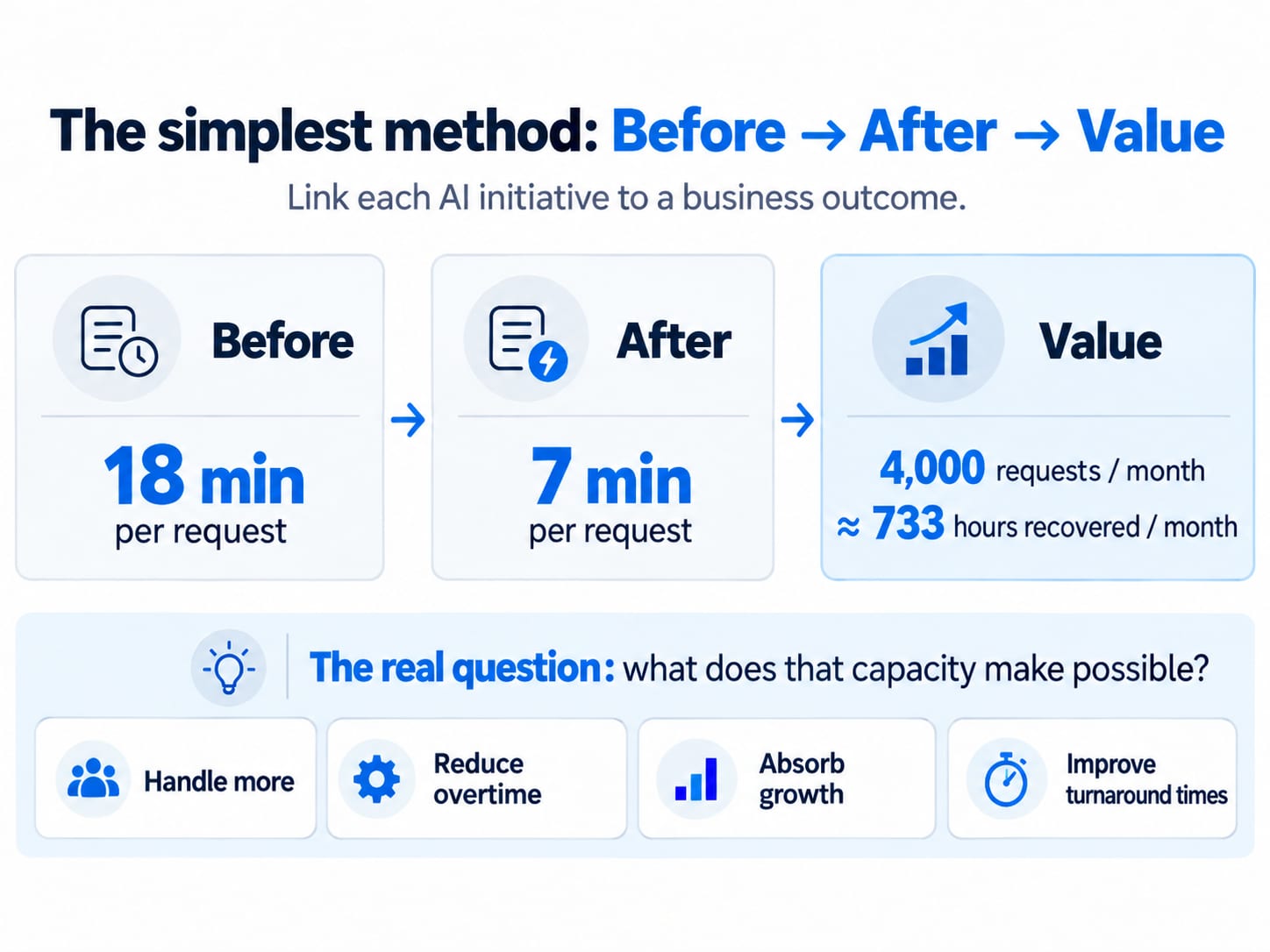
For every important AI agent or automation, ask for three numbers.
1. Before
How did the process perform before AI?
For example: 18 minutes per request.
2. After
How does it perform with AI?
For example: 7 minutes per request.
3. Value
What can the business actually do with the 11 minutes recovered?
Assume 4,000 requests per month.
That represents roughly 733 hours of monthly capacity.
Useful? Absolutely.
But 733 hours of capacity are not automatically 733 hours of economic value.
The organization may use that capacity to handle more work, reduce overtime, absorb growth without proportional hiring, or improve customer response times.
That final step is what converts a productivity gain into a business outcome.
Otherwise, a company can accumulate impressive amounts of “time saved” without ever finding those savings in its financial results. Spreadsheets tend to be very welcoming to good news; the P&L is a little more demanding.
!Before, after, value: link each AI initiative to a business outcome.
Not every agent needs the same KPI
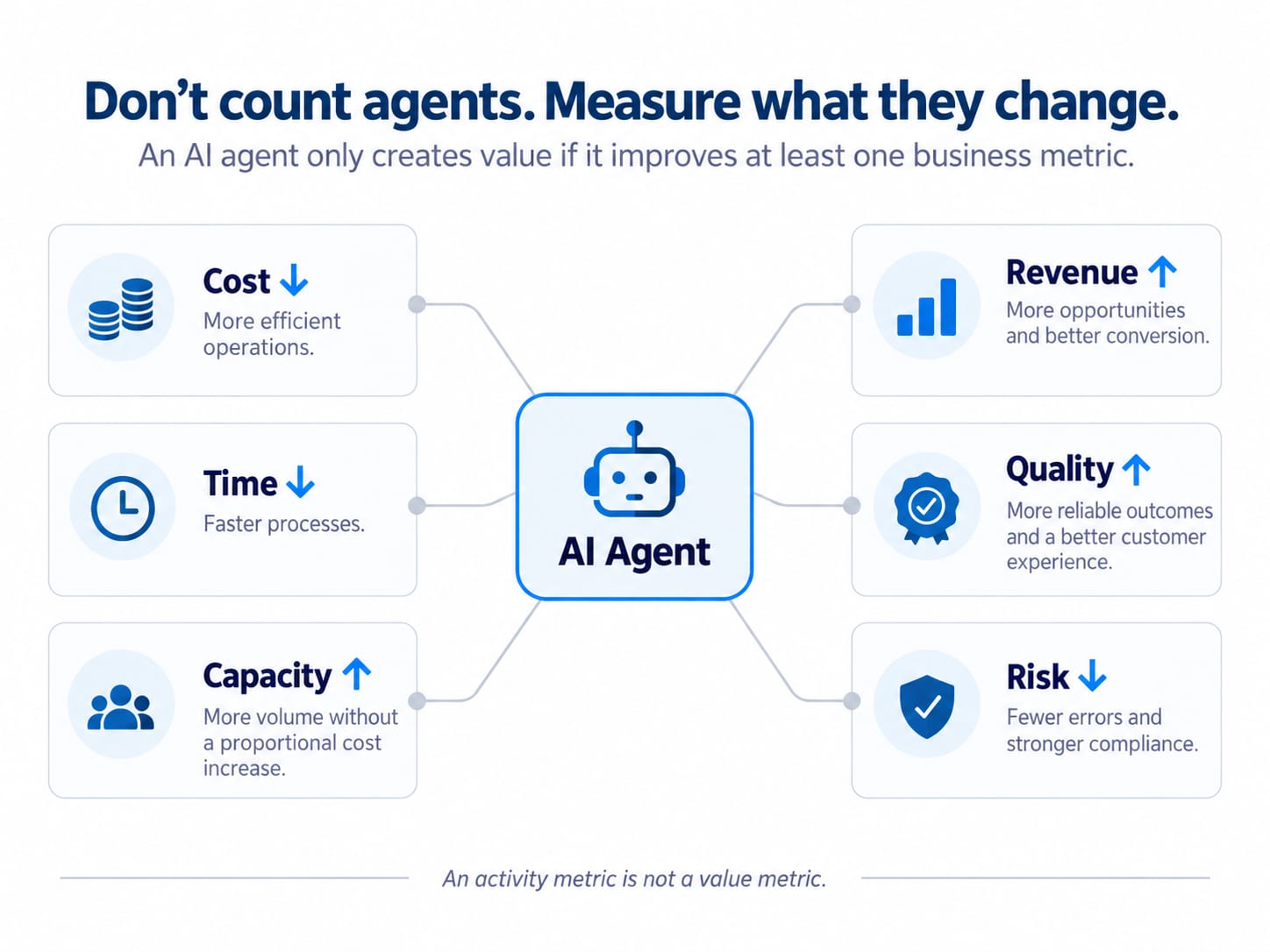
Value does not always mean cutting costs.
It can take several forms:
Cost ↓ · Time ↓ · Capacity ↑ · Revenue ↑ · Quality ↑ · Risk ↓
A service agent might be measured by cost per resolution.
A finance agent by close speed and exception volume.
A sales agent by response time and conversion.
An operations agent by throughput, error reduction or additional capacity.
The metric should follow the business problem the agent was meant to improve, not the technology used to solve it.
The question to ask Monday morning
Take your five most important AI use cases.
For each one, ask the owner:
> “What business metric did we track before AI, and how has it changed since?”
If there is a clear answer, you are starting to measure value.
If the answer is still about the number of agents, users or automated tasks, you are probably still measuring deployment.
That is the difference.
A mature AI organization is not distinguished by how many agents it has. It is distinguished by its ability to show what each one improves.
Sources
- SAP — Powering the Autonomous Enterprise with AI Agents and SAP Cloud ERP Private, September 22, 2026.
- McKinsey — Cutting the “coordination tax”: How agentic AI can reshape workflows, September 18, 2026.
- PwC — How companies can close the AI execution gap in operations, September 10, 2026.