Deploy AI effectively: start with the work, not the technology
Effective AI deployment does not start with choosing a tool. It starts with a business outcome, the workflow that produces it, and the precise role AI should play.
Many companies start their AI deployment with the same question:
Which tool should we choose?
Which model? Which copilot? Which agent? Which platform?
Those decisions matter. But they often come too early.
A company does not create value simply by giving more employees access to AI. It creates value when AI improves how a business outcome is produced: serving a customer, preparing a quote, processing an invoice, qualifying an opportunity, resolving a problem, or making a decision.
> A pilot proves that AI can work. A deployment proves that the business can work with it.
That second step is harder — and more important.
Using AI is not the same as integrating it
U.S. Census Bureau data illustrate the gap.
Among firms already using AI, 57% deploy it in three business functions or fewer. At the worker level, 65% of those firms still limit AI to three tasks or fewer, most often writing, document analysis, and information search. Researchers also observe a positive relationship between firm performance and the breadth of AI integration, while explicitly cautioning that the relationship is not necessarily causal.
In other words, a company can have hundreds of AI users while changing very little about how work actually gets done.
That is often the first stage of adoption: AI is added inside the existing work.
It writes faster. Summarizes a document. Searches for information. Prepares a response.
Useful? Absolutely.
But it leaves a more important question unanswered:
Should the work still flow the same way?
The unit of deployment should be the workflow, not the tool
Recent MIT Sloan work argues for looking at AI not only task by task, but across sequences of tasks: how work is grouped, in what order it is performed, and where responsibility passes between humans and machines.
The implication for leaders is important: value depends as much on how work is organized as on how well AI performs an isolated task. Repeated handoffs between people and AI can create coordination costs that erode expected gains.
Consider a service request received by email.
Today, an employee may need to:
- read the email and attachments;
- identify the customer;
- find the relevant equipment;
- review service history;
- understand the issue;
- enter a new request in the system;
- determine priority;
- assign it;
- reply to the customer.
A first approach is to give the employee a copilot that drafts the reply faster.
A more ambitious approach asks:
Which parts of this chain should still be done this way?
AI could understand the email and attachments, retrieve customer context, prepare or create the service request, apply certain rules, route exceptions to the right person, and confirm receipt.
The value no longer comes from making one task 30% faster.
It comes from changing the flow of work.
Start with the outcome, not the agent
Before discussing technology, define what the business is trying to improve.
For example:
- reduce request-handling time;
- increase first-contact resolution;
- produce quotes faster;
- reduce data-entry errors;
- accelerate billing cycles;
- increase team capacity without increasing headcount proportionally.
This sounds basic. Yet when the desired outcome is vague, AI projects often end up measuring what is easiest to count: active users, prompts sent, agents created, or theoretical hours saved.
Those may not be the outcomes the business intended to improve.
The right sequence starts with:
Which outcome do we want to make better?
Only then:
What role can AI play in achieving it?
Observe how work actually moves
Once the outcome is clear, examine the process end to end.
Not just the visible tasks.
Look at waiting time, handoffs, duplicate entry, information search, approvals, exceptions, and rework.
Stanford Digital Economy Lab studied 51 AI deployments that had actually created value, across 41 organizations, nine industries, and seven countries. One pattern stands out: organizations using comparable technologies can achieve very different outcomes. The researchers attribute much of the difference to organizational readiness, processes, leadership, data, and the ability to change — not simply to model choice.
The lesson is simple:
> A bad process that is automated is still a bad process. It just became faster.
Effective AI deployment sometimes means removing one step before automating three others.
Define the exact role of AI
Not every step in a process should be handed to AI.
For each one, ask:
What role do we want AI to play here?
It can:
Understand — read, extract, classify, search;
Recommend — analyze a situation and suggest an action;
Prepare — build a response, case, or transaction for review;
Execute — perform an authorized action in a system;
Hand off — recognize an exception and route it to the right person.
This avoids a common mistake: asking for “an autonomous agent” before defining what the business actually wants to delegate.
Autonomy is not the objective.
The business outcome is.
Access and authority come next
Once AI's role is defined, two questions become unavoidable.
What information and systems does it need?
Then:
What is it actually allowed to do?
A service agent may need to consult the CRM, ERP, and service history.
That does not mean it should be able to modify everything.
It may be authorized to create a service request, but not approve a large credit. Prepare an order, but wait for approval before confirming it. Answer a routine question, but hand off a contractual exception.
At that point, deployment is no longer only a technology project.
It becomes a decision about how the organization distributes information, authority, and accountability.
Measure the whole flow
A good deployment should answer one simple question:
Is the business outcome better than before?
The right metric depends on the process.
For service: handling time, resolution, throughput, escalations, satisfaction.
For sales: response time, qualification, conversion, time to quote.
For finance: processing time, errors, exceptions, close cycle.
For operations: cycle time, throughput, quality, rework.
MIT's workflow research reinforces the same point: improving an individual task does not guarantee a proportional improvement in the overall system. Dependencies, handoffs, and coordination costs can absorb part of the gain.
So avoid measuring only:
“Is AI faster at this task?”
and ask instead:
“Does the process now produce a better result?”
Only then should you scale
When the first process works, the temptation is often to create more agents quickly.
But the most valuable asset created by that first deployment is not just the agent.
It is everything the organization has learned:
which data is required, which systems must be connected, which rules apply, which decisions require approval, which exceptions occur, and which metrics actually demonstrate value.
Those elements can then be reused elsewhere.
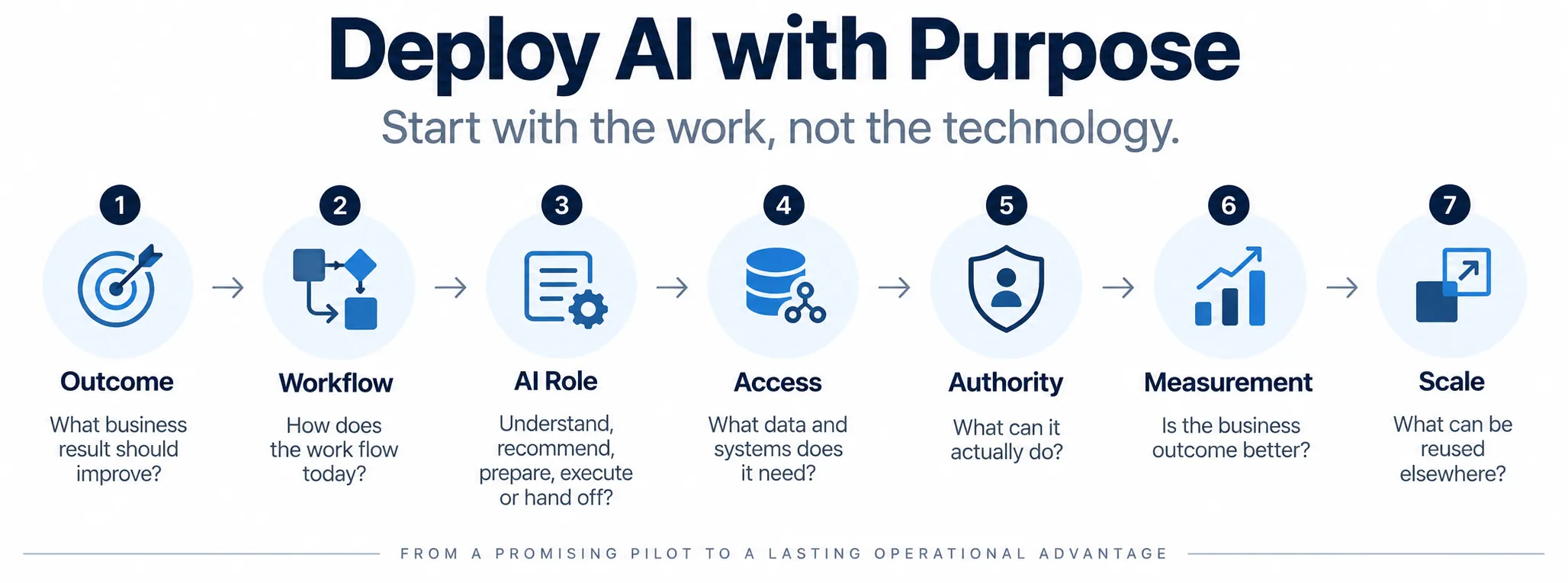
Deployment starts with a business outcome and ends with a reusable organizational capability. Technology supports that journey; it should not define it.
That is when an AI project begins to become an organizational capability.
The first question changes
AI deployment is often presented as a technology project.
For simple use cases, that may be enough.
But once AI spans multiple steps, uses enterprise data, interacts with business systems, and begins to act, broader decisions are required.
Outcome → Workflow → AI Role → Access → Authority → Measurement → Scale
That framework changes the first question leaders should ask.
Instead of:
“Where can we put AI?”
start with:
“Where do we want the work to function better?”
The difference sounds subtle.
It often separates a technology experiment from an operational transformation.
Main sources
- NBER / U.S. Census Bureau — The Microstructure of AI Diffusion: Evidence from Firms, Business Functions, and Worker Tasks, April 2026
- Stanford Digital Economy Lab — The Enterprise AI Playbook: Lessons from 51 Successful Deployments, April 2026
- MIT Sloan — How AI is reshaping workflows and redefining jobs, April 2026