Automation or autonomy: what’s the difference for a business leader?
Automation delegates a defined task. Autonomy gives a system room to decide and act. Here’s the distinction business leaders need to understand.
A process can be highly automated without being autonomous.
A rule can send an invoice as soon as an order is approved. A system can automatically route a case when a threshold is crossed. AI can even recommend the next best action to an employee. In all of these cases, the organization still controls fairly directly what happens next.
Autonomy begins when the system receives room to decide: it can choose an action, execute it, pursue an objective, and sometimes adapt its path without waiting for human approval at every step.
> Automation delegates a defined task. Autonomy delegates a degree of decision-making and authority to act.
That distinction is becoming strategic. In an August 2026 Deloitte survey of 501 U.S.-based senior managers and C-suite executives already involved in agentic AI initiatives, 61% expected that, within four years, most AI agents in use would be generally autonomous, with humans primarily providing oversight. At the same time, 75% said human collaboration with AI agents creates more value than agent-powered automation alone.
Automation follows a rule. Autonomy exercises judgment.
Traditional automation works especially well when the organization can define both the condition and the response in advance.
If X happens, do Y.
That logic already powers a large part of modern operations: route a form, send a reminder, apply a pricing rule, trigger an alert, create a task.
Autonomy introduces something different. The system may have to determine how to achieve the objective.
The OECD describes autonomy as the degree to which an AI system can act without direct human involvement. Its framework distinguishes several levels of action autonomy: a system may only recommend an action; proceed only after human approval; act independently while remaining subject to human intervention; or act without direct human involvement.
In other words, autonomy is not an on/off switch. It is a continuum.
Four levels make the distinction easier to see
| Level | What the system does | Human role | Example |
|---|---|---|---|
| Deterministic automation | Executes a predefined rule | Defines the rule | If an invoice is 30 days overdue, send a reminder |
| AI recommendation | Analyzes the situation and suggests an action | Decides and executes | Suggest prioritizing an at-risk customer |
| Supervised execution | Prepares or initiates an action but waits for approval | Authorizes the action | Prepare a refund, then request approval |
| Bounded autonomy | Chooses and executes certain actions within defined limits | Supervises and handles exceptions | Automatically resolve eligible requests below a specified threshold |
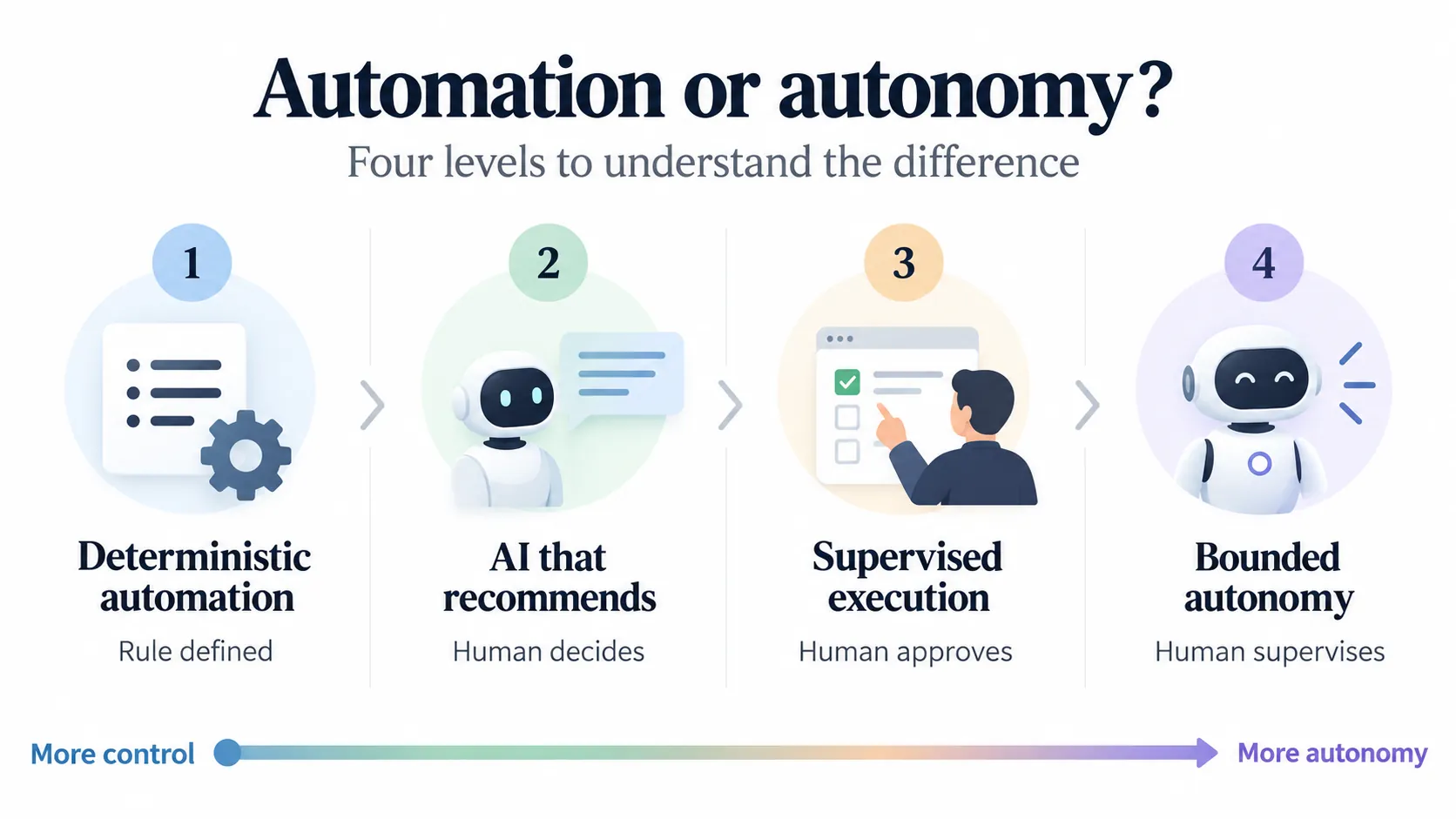
From deterministic automation to bounded autonomy: as freedom of action increases, the human role moves from direct decision-making toward oversight.
This model is intentionally simple. In practice, the same business process can contain several levels of autonomy.
A customer-service agent might answer routine questions automatically, require approval before issuing a $200 credit, and be completely prohibited from changing contractual terms.
So the useful question is not:
“Is this agent autonomous?”
It is:
“Autonomous to do what, to what extent, and under which conditions?”
Risk changes when the system can act
A bad recommendation can often be corrected before anything happens.
A bad action may already have modified a customer record, sent a message, committed spending, or triggered another system.
That changes the nature of the management decision.
The Canadian Centre for Cyber Security recommends a progressive approach to agentic AI: minimal privileges, human control points, monitoring and interruption mechanisms, and gradual increases in autonomy as the organization better understands system behaviour. It also recommends that decisions about when human approval is required be made by system designers and operators rather than delegated to the agent itself.
The issue is no longer only whether the model is accurate.
It is also:
How much organizational authority are we prepared to delegate to a machine?
Autonomy should follow risk, not enthusiasm
Not every process deserves the same level of control.
An organization may reasonably allow greater autonomy for classifying emails, enriching records, routing requests, or handling routine and reversible administrative work.
The equation changes when an action can move significant money, alter credit, create a contractual commitment, expose sensitive information, or materially affect a customer.
A useful way to think about the boundary is through three dimensions:
the potential impact of an error, how reversible the action is, and how quickly the organization can detect that something has gone wrong.
> The more consequential, difficult to reverse, or sensitive an action is, the less autonomy should be granted by default.
The goal is therefore not maximum autonomy.
It is the right level of autonomy in the right place.
The human does not disappear. The role changes.
Autonomous operation does not necessarily mean human-free operation.
The OECD distinguishes, among other models, between human-in-the-loop, where the system waits for approval, and human-on-the-loop, where the system can act while remaining under human supervision.
In a well-designed operating model, people can therefore move gradually from executing every step to managing exceptions, boundaries, and consequences.
That shift may prove more important than the technology itself.
The familiar management question:
“How many tasks can we automate?”
will increasingly need a second one:
“Which decisions do we still want people to make, and which are we prepared to delegate under defined conditions?”
The durable boundary is organizational, not technological
AI agents will continue to become more capable. What is technically possible today is therefore unlikely to remain a useful boundary for long.
The more durable boundary is organizational.
It lies in the permissions the system receives, the decisions it may make, the money it may commit, the systems it may modify, the situations it must escalate, and the evidence it must leave behind.
An organization can deploy extremely capable AI while granting it very little autonomy.
The opposite is also true: a relatively simple system can have major consequences if it holds broad operational authority.
That is why automation and autonomy should not be treated as synonyms.
Automation delegates work. Autonomy delegates part of the authority to act.
And deciding how much authority to delegate is as much a leadership decision as a technology decision.